

7.2: Summary
- Page ID
- 130422
\( \newcommand{\vecs}[1]{\overset { \scriptstyle \rightharpoonup} {\mathbf{#1}} } \)
\( \newcommand{\vecd}[1]{\overset{-\!-\!\rightharpoonup}{\vphantom{a}\smash {#1}}} \)
\( \newcommand{\dsum}{\displaystyle\sum\limits} \)
\( \newcommand{\dint}{\displaystyle\int\limits} \)
\( \newcommand{\dlim}{\displaystyle\lim\limits} \)
\( \newcommand{\id}{\mathrm{id}}\) \( \newcommand{\Span}{\mathrm{span}}\)
( \newcommand{\kernel}{\mathrm{null}\,}\) \( \newcommand{\range}{\mathrm{range}\,}\)
\( \newcommand{\RealPart}{\mathrm{Re}}\) \( \newcommand{\ImaginaryPart}{\mathrm{Im}}\)
\( \newcommand{\Argument}{\mathrm{Arg}}\) \( \newcommand{\norm}[1]{\| #1 \|}\)
\( \newcommand{\inner}[2]{\langle #1, #2 \rangle}\)
\( \newcommand{\Span}{\mathrm{span}}\)
\( \newcommand{\id}{\mathrm{id}}\)
\( \newcommand{\Span}{\mathrm{span}}\)
\( \newcommand{\kernel}{\mathrm{null}\,}\)
\( \newcommand{\range}{\mathrm{range}\,}\)
\( \newcommand{\RealPart}{\mathrm{Re}}\)
\( \newcommand{\ImaginaryPart}{\mathrm{Im}}\)
\( \newcommand{\Argument}{\mathrm{Arg}}\)
\( \newcommand{\norm}[1]{\| #1 \|}\)
\( \newcommand{\inner}[2]{\langle #1, #2 \rangle}\)
\( \newcommand{\Span}{\mathrm{span}}\) \( \newcommand{\AA}{\unicode[.8,0]{x212B}}\)
\( \newcommand{\vectorA}[1]{\vec{#1}} % arrow\)
\( \newcommand{\vectorAt}[1]{\vec{\text{#1}}} % arrow\)
\( \newcommand{\vectorB}[1]{\overset { \scriptstyle \rightharpoonup} {\mathbf{#1}} } \)
\( \newcommand{\vectorC}[1]{\textbf{#1}} \)
\( \newcommand{\vectorD}[1]{\overrightarrow{#1}} \)
\( \newcommand{\vectorDt}[1]{\overrightarrow{\text{#1}}} \)
\( \newcommand{\vectE}[1]{\overset{-\!-\!\rightharpoonup}{\vphantom{a}\smash{\mathbf {#1}}}} \)
\( \newcommand{\vecs}[1]{\overset { \scriptstyle \rightharpoonup} {\mathbf{#1}} } \)
\(\newcommand{\longvect}{\overrightarrow}\)
\( \newcommand{\vecd}[1]{\overset{-\!-\!\rightharpoonup}{\vphantom{a}\smash {#1}}} \)
\(\newcommand{\avec}{\mathbf a}\) \(\newcommand{\bvec}{\mathbf b}\) \(\newcommand{\cvec}{\mathbf c}\) \(\newcommand{\dvec}{\mathbf d}\) \(\newcommand{\dtil}{\widetilde{\mathbf d}}\) \(\newcommand{\evec}{\mathbf e}\) \(\newcommand{\fvec}{\mathbf f}\) \(\newcommand{\nvec}{\mathbf n}\) \(\newcommand{\pvec}{\mathbf p}\) \(\newcommand{\qvec}{\mathbf q}\) \(\newcommand{\svec}{\mathbf s}\) \(\newcommand{\tvec}{\mathbf t}\) \(\newcommand{\uvec}{\mathbf u}\) \(\newcommand{\vvec}{\mathbf v}\) \(\newcommand{\wvec}{\mathbf w}\) \(\newcommand{\xvec}{\mathbf x}\) \(\newcommand{\yvec}{\mathbf y}\) \(\newcommand{\zvec}{\mathbf z}\) \(\newcommand{\rvec}{\mathbf r}\) \(\newcommand{\mvec}{\mathbf m}\) \(\newcommand{\zerovec}{\mathbf 0}\) \(\newcommand{\onevec}{\mathbf 1}\) \(\newcommand{\real}{\mathbb R}\) \(\newcommand{\twovec}[2]{\left[\begin{array}{r}#1 \\ #2 \end{array}\right]}\) \(\newcommand{\ctwovec}[2]{\left[\begin{array}{c}#1 \\ #2 \end{array}\right]}\) \(\newcommand{\threevec}[3]{\left[\begin{array}{r}#1 \\ #2 \\ #3 \end{array}\right]}\) \(\newcommand{\cthreevec}[3]{\left[\begin{array}{c}#1 \\ #2 \\ #3 \end{array}\right]}\) \(\newcommand{\fourvec}[4]{\left[\begin{array}{r}#1 \\ #2 \\ #3 \\ #4 \end{array}\right]}\) \(\newcommand{\cfourvec}[4]{\left[\begin{array}{c}#1 \\ #2 \\ #3 \\ #4 \end{array}\right]}\) \(\newcommand{\fivevec}[5]{\left[\begin{array}{r}#1 \\ #2 \\ #3 \\ #4 \\ #5 \\ \end{array}\right]}\) \(\newcommand{\cfivevec}[5]{\left[\begin{array}{c}#1 \\ #2 \\ #3 \\ #4 \\ #5 \\ \end{array}\right]}\) \(\newcommand{\mattwo}[4]{\left[\begin{array}{rr}#1 \amp #2 \\ #3 \amp #4 \\ \end{array}\right]}\) \(\newcommand{\laspan}[1]{\text{Span}\{#1\}}\) \(\newcommand{\bcal}{\cal B}\) \(\newcommand{\ccal}{\cal C}\) \(\newcommand{\scal}{\cal S}\) \(\newcommand{\wcal}{\cal W}\) \(\newcommand{\ecal}{\cal E}\) \(\newcommand{\coords}[2]{\left\{#1\right\}_{#2}}\) \(\newcommand{\gray}[1]{\color{gray}{#1}}\) \(\newcommand{\lgray}[1]{\color{lightgray}{#1}}\) \(\newcommand{\rank}{\operatorname{rank}}\) \(\newcommand{\row}{\text{Row}}\) \(\newcommand{\col}{\text{Col}}\) \(\renewcommand{\row}{\text{Row}}\) \(\newcommand{\nul}{\text{Nul}}\) \(\newcommand{\var}{\text{Var}}\) \(\newcommand{\corr}{\text{corr}}\) \(\newcommand{\len}[1]{\left|#1\right|}\) \(\newcommand{\bbar}{\overline{\bvec}}\) \(\newcommand{\bhat}{\widehat{\bvec}}\) \(\newcommand{\bperp}{\bvec^\perp}\) \(\newcommand{\xhat}{\widehat{\xvec}}\) \(\newcommand{\vhat}{\widehat{\vvec}}\) \(\newcommand{\uhat}{\widehat{\uvec}}\) \(\newcommand{\what}{\widehat{\wvec}}\) \(\newcommand{\Sighat}{\widehat{\Sigma}}\) \(\newcommand{\lt}{<}\) \(\newcommand{\gt}{>}\) \(\newcommand{\amp}{&}\) \(\definecolor{fillinmathshade}{gray}{0.9}\)Summary and Review Questions
The key elements of emotional intelligence for effective project management are summarized starting with the learning process discussed in chapter 1. The "what," "why," and "how" of each of the four core skills are summarized in the tables below.
Learning Process

The figure illustrates the learning process.
The EQ for Project Management illustrates how leadership and project success are developed through layered skills and experiences, starting with emotions as the base.
- Emotions are the underlying driver of emotional intelligence, and are positioned at the bottom. This foundation highlights the importance of emotional awareness and regulation. Understanding one’s own emotions and recognizing others' emotions lay the groundwork for effective collaboration, communication, and decision-making.
- Above this layer are the Core Skills, divided into two categories.
- The first layer contains the Self-Focused Core Skills, Self-Awareness and Self-Management. They include abilities such as self-management, reflection, and personal accountability. These skills help individuals understand their strengths, regulate their behavior, and develop personal effectiveness.
- The next layer contains the Others-Focused Core Skills, Social Awareness and Relationship Management. They emphasize interpersonal abilities such as communication, empathy, and collaboration. These skills enable individuals to work effectively with teams and build positive relationships.
- The next level is Leadership (Application of Core Skills and More). At this stage, individuals combine their personal and interpersonal skills to guide projects, coordinate teams, and support shared goals. Negotiation and decision-making come into play. Leadership emerges not as a separate skill but as the applied integration of the skills developed in earlier layers.
- Along the right side of the figure, a vertical progression shows stages of learning and application:
- Learn & Recognize the events that trigger the emotions, the resulting behavior, and their impact.
- Apply the learned skills.
- Achieve showing the consistent achievement of the objectives from the skills and successful project outcomes.
- On the left side, a label indicates Case Studies, showing the value of learning from real-world examples and experiences.
Overall, the diagram illustrates that effective leadership and successful outcomes are built step-by-step—from emotional awareness and core skills to applied leadership, tools, and measurable results, with real-life case studies showing how the skills are applied in project scenarios.
Summary of Four Core Skills
Each core skill is summarized using key points only in a table. The detailed descriptions are in the chapters, Self-Focused Core EQ Skills and Others-Focused Core EQ Skills.
Summary of Self-Awareness Sub-Skills
Sub-Skill: Emotional Awareness
| What they are |
|
|---|---|
| Why are they important |
|
| How to manage |
|
Sub-Skill: Action Flags
| What are they |
|
|---|---|
| Why are they important |
|
| How to manage |
|
Sub-Skill: Self-Confidence
| What they are |
|
|---|---|
| Why are they important |
|
| How to manage |
|
Summary of Self Management Sub-Skill
Sub-Skill: Emotional Triggers
| What they are |
|
|
|---|---|---|
| Why are they important |
|
|
| How to manage |
Self-Regulation of Fear and Anger
|
Self-Regulation of Criticism and Blame
|
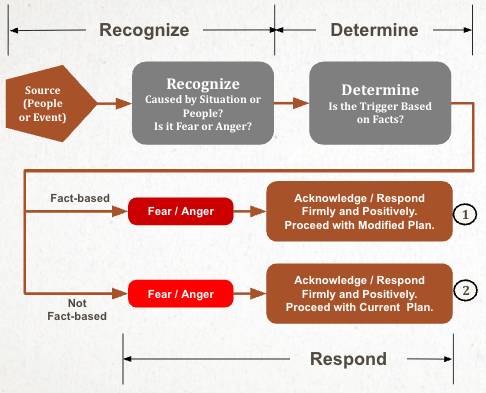

Summary of Social Awareness Sub-Skills
Each sub-skill related to social awareness is listed below in individual tables.
Sub-Skill: Organizational Awareness
| What they are |
|
|---|---|
| Why are they important |
|
| How to manage |
|
Sub-Skill: Active Listening
| What they are |
|
|---|---|
| Why are they important |
Helps us:
|
| How to manage |
|
Sub-Skill: Empathy
| What they are |
|
|---|---|
| Why are they important |
Helps us:
|
| How to manage |
|
Barriers to Empathy
The common barriers to empathy each of which must be avoided are listed in a table below.
| What are they |
|
|---|---|
| Why are they important |
If they are not avoided, they:
|
| How to manage |
|
Summary of Relationship Management Sub-Skills
Sub-Skill: Build and Maintain Trust
| What they are |
|
|---|---|
| Why they are important |
|
| How to manage |
|
Sub-Skill: Manage Conflicts
| What they are |
|
|---|---|
| Why are they important |
If they are not managed, it could lead to:
|
| How to manage |
|
Sub-Skill: Communicate Effectively
| What they are |
|
|---|---|
| Why they are important |
Helps us:
|
| How to manage |
Observe and apply:
|
Sub-Skill: Specific Messages
| What they are |
|
|
|---|---|---|
| Why are they important |
Apart from bringing everyone to one common understanding and building trust, improves the effectiveness of communicating:
|
|
| How to communicate |
To communicate bad news:
|
To communicate gratitude messages:
|
Summary of Leadership
Sub-Skill: Active Listening (for Leadership)
| What they are |
|
|---|---|
| Why they are important |
Helps us:
|
| How to manage |
|
Sub-Skill: Negotiation (for Leadership)
| What they are |
|
|---|---|
| Why they are important |
|
| How to manage |
Use the four principles of negotiation:
|
Sub-Skill: Conflict Management (for Leadership)
| What they are |
|
|---|---|
| Why are they important |
|
| How to manage |
Use the five methods of managing conflicts:
|
Sub-Skill: Decisiveness (for Leadership)
| What they are |
|
|---|---|
| Why they are important |
Helps us:
|
| How to manage |
Use the three factors that help you make better decisions:
|
Review Questions
- What are the leadership skill sets the 6th Edition of PMBOK guide suggests?
- What are the four principles of negotiation?
- What are the two dimensions Thomas-Kilmann uses to describe a person's behavior in conflict?
- What are the four skills needed to be decisive?
- What are the leadership styles?