

3.6.8: Thermoelectrics
- Page ID
- 88141
Thermoelectrics (TEs) are materials that convert heat to electricity via the Seebeck effect. This unique ability of TEs is dependent upon electronic and thermal properties. The dimensionless figure of merit (zT) is used to quantify TE performance, and is related to the conversion efficiency (η). TEs optimizing energy conversion are currently used in radioisotope thermoelectric generators (RTGs) to generate electricity for spacecraft and other inaccessible power systems. As Figure 1 shows, TE generators consist of the series of n-type and p-type materials bridging the gap between a heat source and heat sink to create a current.
Material Properties
The performance of TEs is related to their Seebeck coefficient, electrical conductivity, and thermal conductivity. The Seebeck coefficient relates change in voltage to change in temperature, and is given by the equation:
\[ S(T)=\dfrac{\Delta V}{\Delta T} = -\dfrac{\pi ^{2}k_{B}^{2}T}{2eE_{F}} \label{1}\]
where \(k_B\) is the Boltzmann constant, \(e\) is the elementary charge of an electron, and \(E_F\) is the Fermi energy at 0K.
The electrical conductivity σ of materials is given by the Drude conductivity equation:
\[ \sigma = ne\mu \label{2}\]
Where n is the concentration of charge carriers and μ is the drift mobility of charge carriers. The thermal conductivity of materials is given by the equation:
\[ \kappa =\kappa _{lattice} + \kappa _{electron} =\kappa _{lattice} + L \sigma T \label{3}\]
Where κ is the total thermal conductivity, κlattice and κelectron are the lattice and electron contributions to thermal conductivity respectively, and L is the Lorentz number. In nonmetals, the mobility of mechanical energy in the form of lattice vibrations (phonons) dominates total thermal conductivity. In metals, however, the abundance of conducting electrons is contributes significantly to thermal conduction.
Thermoelectric Performance
TE performance is characterized by zT, or a dimensionless value that relates material properties to conversion efficiency. The equation for zT is:
\[ zT=\dfrac{S^{2}\sigma T}{\kappa} \label{4}\]
Therefore, in order to optimize a material for TE conversion, the Seebeck coefficient and electrical conductivity must be maximized, while thermal conductivity is minimized. zT is related to the efficiency of the TE by the relationship:
\[ \eta \alpha \sqrt{ 1 + zT_{AVE}} \label{5}\]
where \(zT_{AVE}\) is the average figure of merit from the temperature of the cold side to the temperature the hot side of the TE. As \(zT\) approaches infinity, \(η\) approaches the Carnot efficiency (i.e., the thermodynamic efficiency limit) of a reversible process.
While the Carnot efficiency is a theoretical upper limit of TE performance, complications arising from interrelated properties affecting zT obstruct TE optimization. Semiconductor materials are typically used as TEs because the electronic properties of semiconductors can be manipulated easily. In particular, the carrier concentration and Fermi energy of bulk semiconductors can be adjusted with doping to maximize electrical conductivity and the Seebeck coefficient. Semiconductors also have lower thermal conductivity than metals. Because the Seebeck coefficient and zT are proportional to temperature and \(zT\) is proportional to the Seebeck coefficient squared, higher temperatures result in higher \(zT\). Temperature’s proportionality to electron thermal conductivity and inverse proportionality to electrical conductivity (in semiconductors) results in a competing temperature dependence in \(zT\) that limits TE performance.
TE performance has also been limited by structure. Crystalline materials have long-range order that result in relatively high electrical conductivity, as charge carriers can move directionally within the lattice with minimal restriction. Because electrical conduction contributes to thermal conduction, higher crystallinity in a material correlates to higher thermal conductivity. Conversely, the amorphous structure of glasses results in low electrical conductivity and low thermal conductivity. To maximize \(zT\), materials that interact with electrons like crystals and with phonons like glasses are being researched, which have high electrical conductivity and low thermal conductivity due to selective scattering.
Applications of Thermoelectrics
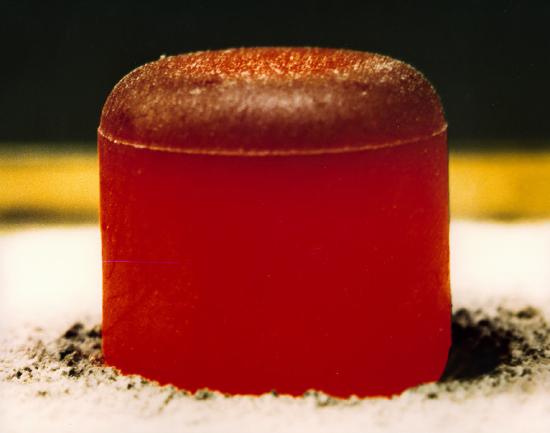 ffect to produce a characteristic voltage for a given temperature, thermocouples used for temperature measurement are not optimized for maximum thermoelectric efficiency. In contrast, TEs for power generation are designed to maximize zT. TEs are most commonly used in RTGs for long-term space missions like deep space exploration. RTGs use the heat emitted from radioactive decay (as shown in Figure 2) and the cold of space to create the temperature difference necessary for energy conversion. Arrays of multiple TE devices are used to generate sufficient electricity. The combination of the reliability of TEs, the energy density of radioisotopes, and the necessity of isolated operation make TEs ideal for powering onboard electronics on long-term space missions. RTGs are used often by NASA in space missions, as power sources on deep-space probes like Voyager and on rovers like Curiosity.
.jpg?revision=1&size=bestfit&width=258&height=194)
Questions
- What material properties affect figure of merit (zT)?
- What limits thermoelectric (TE) efficiency?
- What is the difference between a thermocouple and a TE for power generation?
Answers
- zT is inversely proportional to thermal conductivity and proportional to electrical conductivity, operating temperature, and the square of the Seebeck coefficient.
- In theory, TE efficiency is limited only by the thermodynamically imposed Carnot efficiency, but the interrelation of material properties with respect to temperature and structure have limited TE efficiencies in practice.
- While both thermocouples and thermoelectrics rely on the Seebeck effect to convert heat to electricity, thermocouples create a characteristic voltage that is used to measure temperature and are not optimized for zT and efficiency.
References
- S. K. Bux, J. Fleurial, et al. “Engineering of Novel Thermoelectric Materials and Devices for Next Generation, Long Life, 20% Efficient Space Power Systems,” 11th International Energy Conversion Engineering Conference, July 2013.
- T. M. Tritt, M. G. Kanatzidis, et al. "Thermoelectric materials - new directions and approaches," Proc. 1997 Materials Research Society, 1997, vol. 478, p. 25
- S. O. Kasap, Principles of Electronic Materials and Devices. 3rd ed. McGraw-Hill. 2005.
- E.S. Toberer, A. Zevalkink, and G. J. Snyder, "Phonon engineering through crystal chemistry," J. Mater. Chem., 2011, vol. 21, p. 15843-.
- J.H. Grebenkemper, Y. Hu, et. al., “High Temperature Thermoelectric Properties of Yb14MnSb11 Prepared from Reaction of MnSb with the Elements,” Chemistry of Materials, vol. 27, no. 16, pp. 5791-5798, August 2015