

1.4: Units of measurement and scale
- Page ID
- 120356

\( \newcommand{\vecs}[1]{\overset { \scriptstyle \rightharpoonup} {\mathbf{#1}} } \)
\( \newcommand{\vecd}[1]{\overset{-\!-\!\rightharpoonup}{\vphantom{a}\smash {#1}}} \)
\( \newcommand{\dsum}{\displaystyle\sum\limits} \)
\( \newcommand{\dint}{\displaystyle\int\limits} \)
\( \newcommand{\dlim}{\displaystyle\lim\limits} \)
\( \newcommand{\id}{\mathrm{id}}\) \( \newcommand{\Span}{\mathrm{span}}\)
( \newcommand{\kernel}{\mathrm{null}\,}\) \( \newcommand{\range}{\mathrm{range}\,}\)
\( \newcommand{\RealPart}{\mathrm{Re}}\) \( \newcommand{\ImaginaryPart}{\mathrm{Im}}\)
\( \newcommand{\Argument}{\mathrm{Arg}}\) \( \newcommand{\norm}[1]{\| #1 \|}\)
\( \newcommand{\inner}[2]{\langle #1, #2 \rangle}\)
\( \newcommand{\Span}{\mathrm{span}}\)
\( \newcommand{\id}{\mathrm{id}}\)
\( \newcommand{\Span}{\mathrm{span}}\)
\( \newcommand{\kernel}{\mathrm{null}\,}\)
\( \newcommand{\range}{\mathrm{range}\,}\)
\( \newcommand{\RealPart}{\mathrm{Re}}\)
\( \newcommand{\ImaginaryPart}{\mathrm{Im}}\)
\( \newcommand{\Argument}{\mathrm{Arg}}\)
\( \newcommand{\norm}[1]{\| #1 \|}\)
\( \newcommand{\inner}[2]{\langle #1, #2 \rangle}\)
\( \newcommand{\Span}{\mathrm{span}}\) \( \newcommand{\AA}{\unicode[.8,0]{x212B}}\)
\( \newcommand{\vectorA}[1]{\vec{#1}} % arrow\)
\( \newcommand{\vectorAt}[1]{\vec{\text{#1}}} % arrow\)
\( \newcommand{\vectorB}[1]{\overset { \scriptstyle \rightharpoonup} {\mathbf{#1}} } \)
\( \newcommand{\vectorC}[1]{\textbf{#1}} \)
\( \newcommand{\vectorD}[1]{\overrightarrow{#1}} \)
\( \newcommand{\vectorDt}[1]{\overrightarrow{\text{#1}}} \)
\( \newcommand{\vectE}[1]{\overset{-\!-\!\rightharpoonup}{\vphantom{a}\smash{\mathbf {#1}}}} \)
\( \newcommand{\vecs}[1]{\overset { \scriptstyle \rightharpoonup} {\mathbf{#1}} } \)
\(\newcommand{\longvect}{\overrightarrow}\)
\( \newcommand{\vecd}[1]{\overset{-\!-\!\rightharpoonup}{\vphantom{a}\smash {#1}}} \)
\(\newcommand{\avec}{\mathbf a}\) \(\newcommand{\bvec}{\mathbf b}\) \(\newcommand{\cvec}{\mathbf c}\) \(\newcommand{\dvec}{\mathbf d}\) \(\newcommand{\dtil}{\widetilde{\mathbf d}}\) \(\newcommand{\evec}{\mathbf e}\) \(\newcommand{\fvec}{\mathbf f}\) \(\newcommand{\nvec}{\mathbf n}\) \(\newcommand{\pvec}{\mathbf p}\) \(\newcommand{\qvec}{\mathbf q}\) \(\newcommand{\svec}{\mathbf s}\) \(\newcommand{\tvec}{\mathbf t}\) \(\newcommand{\uvec}{\mathbf u}\) \(\newcommand{\vvec}{\mathbf v}\) \(\newcommand{\wvec}{\mathbf w}\) \(\newcommand{\xvec}{\mathbf x}\) \(\newcommand{\yvec}{\mathbf y}\) \(\newcommand{\zvec}{\mathbf z}\) \(\newcommand{\rvec}{\mathbf r}\) \(\newcommand{\mvec}{\mathbf m}\) \(\newcommand{\zerovec}{\mathbf 0}\) \(\newcommand{\onevec}{\mathbf 1}\) \(\newcommand{\real}{\mathbb R}\) \(\newcommand{\twovec}[2]{\left[\begin{array}{r}#1 \\ #2 \end{array}\right]}\) \(\newcommand{\ctwovec}[2]{\left[\begin{array}{c}#1 \\ #2 \end{array}\right]}\) \(\newcommand{\threevec}[3]{\left[\begin{array}{r}#1 \\ #2 \\ #3 \end{array}\right]}\) \(\newcommand{\cthreevec}[3]{\left[\begin{array}{c}#1 \\ #2 \\ #3 \end{array}\right]}\) \(\newcommand{\fourvec}[4]{\left[\begin{array}{r}#1 \\ #2 \\ #3 \\ #4 \end{array}\right]}\) \(\newcommand{\cfourvec}[4]{\left[\begin{array}{c}#1 \\ #2 \\ #3 \\ #4 \end{array}\right]}\) \(\newcommand{\fivevec}[5]{\left[\begin{array}{r}#1 \\ #2 \\ #3 \\ #4 \\ #5 \\ \end{array}\right]}\) \(\newcommand{\cfivevec}[5]{\left[\begin{array}{c}#1 \\ #2 \\ #3 \\ #4 \\ #5 \\ \end{array}\right]}\) \(\newcommand{\mattwo}[4]{\left[\begin{array}{rr}#1 \amp #2 \\ #3 \amp #4 \\ \end{array}\right]}\) \(\newcommand{\laspan}[1]{\text{Span}\{#1\}}\) \(\newcommand{\bcal}{\cal B}\) \(\newcommand{\ccal}{\cal C}\) \(\newcommand{\scal}{\cal S}\) \(\newcommand{\wcal}{\cal W}\) \(\newcommand{\ecal}{\cal E}\) \(\newcommand{\coords}[2]{\left\{#1\right\}_{#2}}\) \(\newcommand{\gray}[1]{\color{gray}{#1}}\) \(\newcommand{\lgray}[1]{\color{lightgray}{#1}}\) \(\newcommand{\rank}{\operatorname{rank}}\) \(\newcommand{\row}{\text{Row}}\) \(\newcommand{\col}{\text{Col}}\) \(\renewcommand{\row}{\text{Row}}\) \(\newcommand{\nul}{\text{Nul}}\) \(\newcommand{\var}{\text{Var}}\) \(\newcommand{\corr}{\text{corr}}\) \(\newcommand{\len}[1]{\left|#1\right|}\) \(\newcommand{\bbar}{\overline{\bvec}}\) \(\newcommand{\bhat}{\widehat{\bvec}}\) \(\newcommand{\bperp}{\bvec^\perp}\) \(\newcommand{\xhat}{\widehat{\xvec}}\) \(\newcommand{\vhat}{\widehat{\vvec}}\) \(\newcommand{\uhat}{\widehat{\uvec}}\) \(\newcommand{\what}{\widehat{\wvec}}\) \(\newcommand{\Sighat}{\widehat{\Sigma}}\) \(\newcommand{\lt}{<}\) \(\newcommand{\gt}{>}\) \(\newcommand{\amp}{&}\) \(\definecolor{fillinmathshade}{gray}{0.9}\)By the end of this section, learners will be able to
- Describe the two primary systems of measurement: U.S customary units and the metric system.
- Specify the scale of a technical drawing.
- Apply the engineer's, architect's, and metric scale rulers for drawing and measurement.
- Create a scaled drawing of an object or a specific view.
- Measure dimensions on a scaled drawing.
This section covers two measurement systems: U.S. customary units and the International System of Units (SI Units). Engineers need to be familiar with both systems and their conversions. Below are some conversion factors for reference.
- The U.S. customary system is commonly used in the United States and includes units of length such as feet, inches, and yards.
- Most of the world works with SI Units, which use units like millimeters, centimeters, meters, and kilometers.
U.S. customary units
Units: yards (yd), feet (ft), inches (in)
- 1 yd =3 ft
- 1 ft =12 in
The metric system (SI Units, International system of units)
Units: millimeters (mm), centimeter (cm), decimeter (dm), meter (m), kilometer (km)
- 1 mm =0.001m (1/1000 meter)
- 1 cm =0.01m (1/100 meter)
- 1 dm =0.1m (1/10 meter)
- 1 m =100 cm =1000 mm
- 1 km =1000 m
Conversions
- 1 m =3.28 ft =1 m 3 ft 3.37 in
- 1 ft =0.305 m
- 1 in =2.54 cm =25.4 mm
The Mars climate orbiter
On December 11, 1998, NASA launched an orbiter designed to study Mars' climate. However, the mission failed when the orbiter was lost in September 1999 as it entered the planet’s atmosphere. The failure was caused by a unit conversion error between the orbiter’s onboard computer and ground systems, resulting in a miscalculated trajectory. Although no human lives were at risk, the incident resulted in a significant financial loss for NASA (Mars Climate Orbiter - NASA Science 2017).
This example highlights the importance of understanding units and their conversions. Including units in calculations and measurements is essential, as a number without a unit does not provide sufficient or meaningful information.
Drawing scale
Depending on the actual size of the represented object, it is often necessary to reduce or enlarge its size on a drawing. For example, large structures such as bridges or buildings cannot be drawn at full scale (actual size) and must be reduced to fit the sheet. Conversely, very small objects—like a computer chip—need to be enlarged in drawings to visualize and describe their details and features. The scale of a drawing is the reduction or enlargement of the size of a drawn object relative to its actual size.
There are different ways to specify the scale of a drawing. It can be specified as a ratio, such as 1:2, 1:3, or 1:5, where the first term of the ratio refers to the number of units on the drawing, while the second term of the ratio references the actual units. For example, a scale of 1:2 means that one unit on the drawing represents two actual units. If the drawing units are inches, in this example, 1 inch on the drawing represents 2 inches in reality. Therefore, the object is drawn at half its actual size or half scale. Similarly, a ratio of 1:3 indicates that the object is drawn three times smaller, where one unit on the drawing represents three actual units.
Scales can be specified in various formats, including ratios, decimals, or fractions. For example, a half scale can be written as a ratio (1:2), a decimal (0.5), or a fraction (1/2). All of these formats represent the same scale, where the drawing is half the size of the actual object.
On the title block of a technical drawing sheet, a scale of 4:1 is specified. What does it mean?
Solution
This example illustrates an enlargement scale. As explained above, the first term of the ratio indicates the number of units on the drawing, while the second term of the ratio represents the actual units of the represented object. A 4:1 scale means that four units on the drawing represent one actual unit. If the units are inches, 4 inches on the drawing represent 1 inch in reality, meaning the object is drawn four times larger than its actual size..
Scaled Rulers
Scaled rulers are tools used to draw an object to scale or to measure the actual dimensions of objects represented in scaled drawings. This section explains how to use an engineer's scale, an architect's scale, and a metric scale.
Engineer's scale (U.S. customary units)
The engineer's scale is also known as the civil engineer's scale because it was used to draw and measure large structures. It is a decimal scale that uses one inch as its base unit. Each side of the ruler is marked by a number ranging from 10 to 60. These numbers are called divisions and indicate in how many equal parts an inch is divided into on that side. The side marked with the 10 division is also referred to as the full scale, because the distance between zero and one equals one actual inch. This inch is divided into 10 equal parts by small dashes. This side is used for scales such as 1" = 1", 1" = 10", and 1" = 1'. When using the side marked 20, the distance between zero and two equals one actual inch, divided into 20 equal parts. This side is used for scales such as 1" = 2", 1" = 20", and 1" = 2'. Similarly, the side marked 30 divides one inch into 30 equal parts and is used for scales such as 1" = 3", 1" = 30", and 1" = 3'. The same logic is applied to divisions 40, 50, and 60.
Below is a table listing the six divisions, their corresponding ratios, and examples of scales for which they are used.
| Division | Ratio | Scales | ||
|---|---|---|---|---|
|
10 (1 inch is divided into 10 equal parts) |
1:1 | 1" =1" | 1" =1' | 1" =10' |
| 20 (1 inch is divided into 20 equal parts) | 1:2 | 1" =2" | 1' =2' | 1" =20' |
| 30 (1 inch is divided into 30 equal parts) | 1:3 | 1" =3" | 1' =3' | 1" =30' |
| 40 (1 inch is divided into 40 equal parts) | 1:4 | 1" =4" | 1" =4' | 1" =40' |
| 50 (1 inch is divided into 50 equal parts) | 1:5 | 1" =5" | 1" =5' | 1" =50' |
| 60 (1 inch is divided into 60 equal parts) | 1:6 | 1" =6" | 1" =6' | 1" =60' |
Table 1.4.1 Engineer's scale divisions and corresponding ratios
The line between points A and B is drawn at a 1"=50' scale (see image below). Using the engineer's scale, can you determine the actual distance?

Solution
- Determine which side of the ruler to use for measuring the distance. In this example, the correct side of the ruler is the side marked by the division 50. On this side of the ruler, one actual inch is divided into 50 equal parts. Therefore, the distance between zero and five on the ruler represents one inch—the small dashes between zero and five divide that inch into 50 equal segments.

- Once the correct side of the ruler is identified, you can read measurements. Since the scale is 1" = 50', the distance from zero to five in the drawing represents 50 feet in reality. Continuing along the scale, the distance from zero to 12 represents 120 feet.

- Since the measured line extends beyond 12, it is necessary to count the divisions (dashes) after the number 12 to determine the whole dimension. In this example, there are three dashes after 12, so the total length is 123 feet at a scale of 1" = 50'.
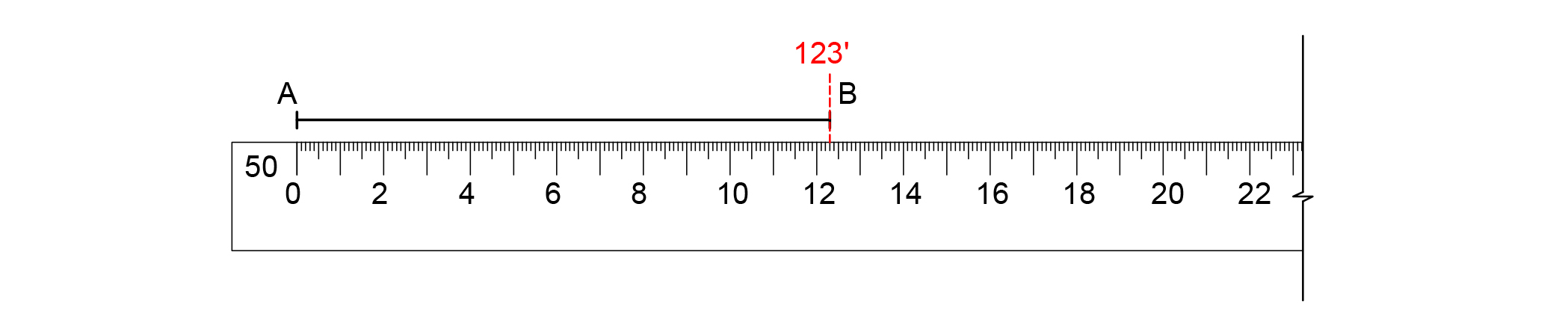
Note: If the drawing scale were 1" = 5', the measured length would need to be divided by 10. In that case, the total length of line A-B would be 12.3 feet.
Please note the importance of including units in your solution. For example, if the drawing scale were 1" = 5", the length would be 12.3 inches, which is very different from 12.3 feet.
Try solving this exercise again using the scales 1" = 500', 1" = 500", and 1' = 5'.
Architect's scale (U.S. customary units)
The sides of an architect's scale are marked with numbers or fractions that indicate different drawing scales. A typical 6-sided triangular scale includes two scales on five of its edges, allowing it to be read from either direction—left to right or right to left. One edge is marked with a single number, 16, which represents full scale (1" = 1"). The number 16 refers to the division of one inch into sixteenths.
On the other five edges, the numbers or fractions represent the number of inches on the drawing that correspond to one foot in actual size. For example, the edge marked 1/2 means that 1/2 inch on the drawing equals 1 foot in reality, or 1/2" = 1'. On each of these five edges, the distance representing one foot is subdivided into smaller increments just to the left of the zero mark. Common scale combinations on the ruler include: 1/2 and 1, 1/8 and 1/4, 1½ and 3, 3/8 and 3/4, and 3/32 and 3/16.
The line between points A and B is drawn at a 1/8"=1' scale (see image below). Using the architect's scale, can you determine the actual distance?

Solution
- Determine which side of the ruler to use for measuring the distance. In this example, the correct side of the ruler is the side marked by the fraction 1/8 and the measurement can be read from left to right.

- Align point A with zero on the architect's scale and read the closest dimension at point B. In this example, the measurement is 19 feet.

- Slide the ruler to align point B with 19 on the architect's scale, then read the number of inches by counting the dashes to the left of zero. In this example, the total measurement is 19'-8".

Note: When reading this side of the ruler from the other direction (right to left), it is possible to measure a distance at a 1/4" = 1' scale.
Metric scale (SI units)
The metric scale uses the meter as its main unit of measurement. On a 6-sided triangular scale, each edge is marked with a ratio (e.g., 1:100), and the distance between 0 and 1 on each side of the ruler represents 1 meter at the indicated scale. For example, the edge marked 1:100 means that 1 millimeter on the drawing represents 100 millimeters in real life. Therefore, 10 millimeters on the drawing equal 1,000 millimeters (or 1 meter) in reality. This edge is also referred to as the full scale because the distance between 0 and 1 on the scale represents 1 actual centimeter as well as 1 meter at the scale 1:100. In fact, 1 centimeter equals to 1 meter at a 1:100 scale, given that 1 centimeter is 1 hundredth of a meter.
There are different metric scales. Common scales include 1:100, 1:50, 1:40, 1:20, 1:331/3, 1:80, 1:200, 1:250, 1:300, 1:500, 1:400.
If the scale on the drawing differs from the scale on the ruler by a power of 10, the value of 1 on the ruler should be multiplied or divided by 10, 100, 1000, etc., depending on the drawing scale. For example, if the drawing is at a 1:1000 scale, it is possible to use the 1:100 side of the ruler and multiply all measurements by 10. Conversely, if the drawing is at a 1:10 scale, the 1:100 side of the ruler can still be used, but each measurement should be divided by 10.
The line between points A and B is drawn at a 1:50 scale (see image below). Using the metric scale, can you determine the actual distance?

Solution
- Determine which side of the ruler to use for measuring the distance. In this example, the correct side is marked with the ratio 1:50. This side of the metric scale can be used for measurements at scales such as 1:5, 1:50, or 1:500.

On the metric scale, the distance between 0 and 1 on each side of the ruler represents one meter at the scale indicated. In this example, the drawing scale matches the scale marked on the ruler. Therefore, the distance between zero and one on the drawing represents one actual meter

- Determine the total distance. The small increments between the numbers represent centimeters and help measure the length accurately. In this example, the length of line A-B at a 1:50 scale is 3.12 meters, or 3 meters and 12 centimeters.

Note: If the drawing scale were 1:500, the measurements would need to be multiplied by 10. In that case, the distance between 0 and 1 on the ruler represents 10 meters, making the total length of line A-B equal to 31.2 meters, or 31 meters and 20 centimeters.
Try solving this exercise again using the scales 1:5 and 1:5,000.